Case study / Build
Hey GlassDollar, how might we show corporations open to work with startups?
Years of venture-client research, opened up as a directory anyone can explore.
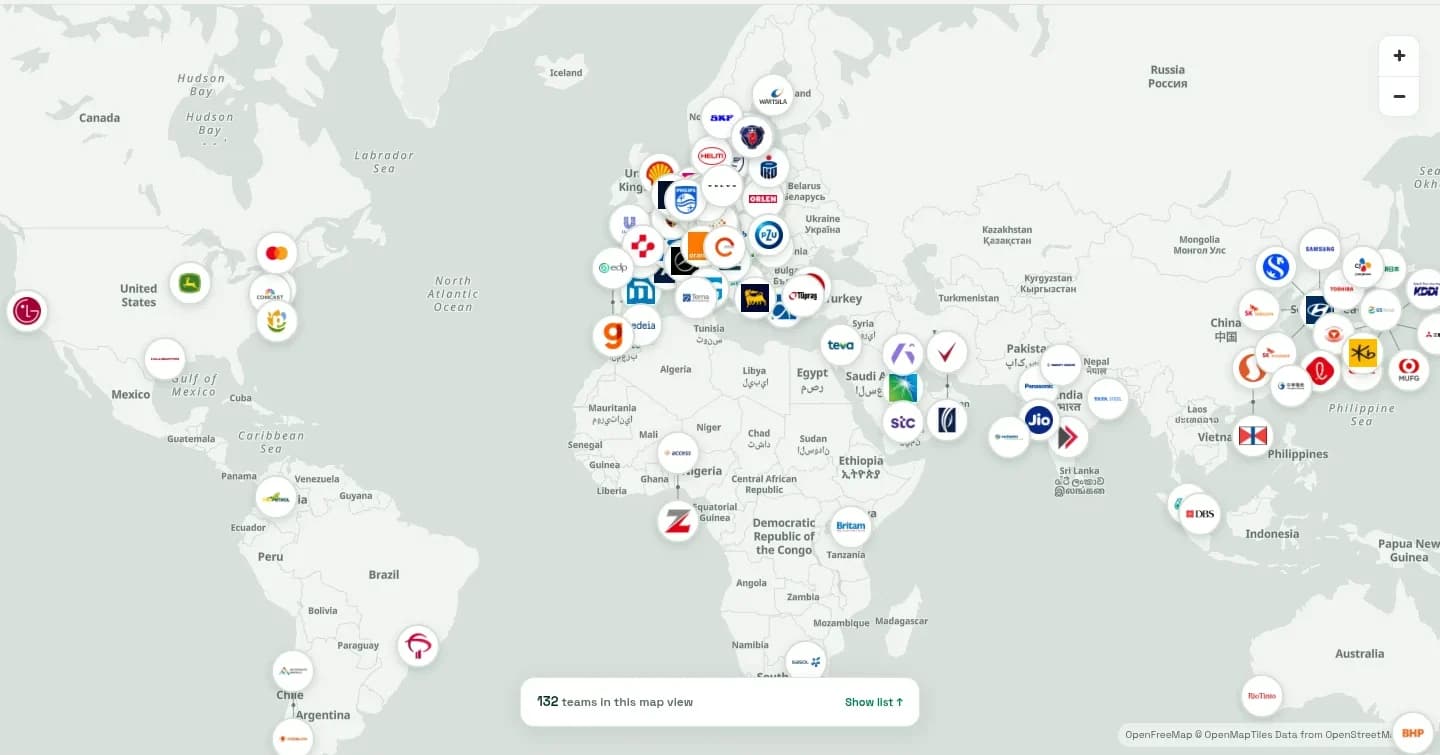
GlassDollar had years of research on which corporations work with startups, sitting in slide decks and static maps. Four weeks after kickoff it was a live directory: 132 curated profiles across 33 countries, and within weeks the first business leads.
to business leads.

Frederic Pampus
Partnerships, Strategy & Growth Lead, GlassDollar
From the client
I can highly recommend working with SANE/REBELS. The team not only thinks strategically and builds fast, but is also nice to work with.
On this page
- Kickoff to live
- 4 weeks
- Curated profiles
- 132
- Countries
- 33
- Lead pipeline in weeks, reported by GlassDollar
- Six-figure
Step 1
The asset was already there.
GlassDollar knows which corporations buy from startups. The hard part is reaching the right person inside them. The research existed: years of it, plus maps of venture-client units that were their best-performing LinkedIn posts. None of it lived anywhere a founder could search.
The directory gives that research a public home. A founder searches it and finds a way in. A company finds itself on it and takes over its own profile.
Step 2
Three decisions that made it useful.
Curated, and small on purpose. 132 venture-client units and startup programmes, each with a real way in, chosen from tens of thousands of corporate names in the data.
The company gets the last word. Any company can claim its profile, correct it or submit a new one, with a work email on its own domain. GlassDollar reviews before anything changes on the map.
Sources on every profile. Each entry links to what it was built from, and a profile the company has confirmed carries a verified badge.
Step 3
Making 132 profiles worth reading.
Generating profiles is cheap. Cleaning the data underneath is where the weeks went: company names that appeared in three spellings, sources that did not support what they were cited for, partners that turned out to be agencies or subsidiaries, sites that no longer existed. Each profile went through the same checks before it appeared: names normalised, every source read and graded, dead links removed, and a second pass on anything that changed.
The same rules now run on every new submission, so the map stays as clean as it launched. A person signed off every profile that went live, built from publicly available sources. AI helped find the candidates, sharpen the profiles and speed up the build.
Step 4
Launch week: shipped from what people asked for.
Once real users arrived, the requests got specific: narrower search, a sign-up link a company can forward, a way for the team to review contributions without a separate conversation for each. Those became releases within days.
GlassDollar runs the studio themselves: requests, corrections and new profiles in one inbox, with change history and undo. Their own Slack bot tells the team when a company claims a profile or asks for a change. Every change goes to a preview environment first.
- Aug 12Kickoff. Research, static maps and a prototype on the table.
- Aug 14First version on real data, on staging.
- Aug 18Ten days of holiday.
- Sep 7The map as the main page, and the private studio for the team.
- Sep 8Launch: 132 profiles, 33 countries, live on GlassDollar's domain.
- Sep 9Ranked search with filters, and a search sheet that works on a phone.
- Sep 10A sign-up link a company can forward to a colleague.
- Sep 12Verified badges, and clear rules for what counts as evidence.
Result
Live, and already producing leads.
The directory runs on GlassDollar's domain. Every profile is a page search engines and AI assistants can read, so a founder asking "which corporates in energy work with startups" can land on it.
Within weeks, GlassDollar reported the first business leads and a potential pipeline in the six figures. Early, and still to be closed. The map itself does what it says on its first screen: explore corporations with a structured approach to working with startups, based on public sources, mainly company websites, and direct company submissions. So that innovation can happen more openly, and GlassDollar can give back to the community and learn from and with them.